


Nostalgia Audio Pendragon Review: Where Music Reborns
For those who have been enjoying the in-ear audiophile hobby for some time now, you must have heard about the passionate custom in-ear brand from Hong Kong, named Nostalgia Audio. Despite their younger age, Nostalgia Audio has been offering impressive and well-curated products, varying from IEMs, custom in-ears, cables, and eartips. The Nostalgia Audio team has made a notable impact in the community amidst a competitive industry – exemplified by the widely used Nostalgia XWB (Xtra Wide Bore) eartips, the renowned flagship IEMs Camelot and Tesseract, and their premium collaboration IEM, Durandal.
However, it’s been quite a while since Nostalgia made a comeback for the successor of their flagship IEMs until recently, with the new TOTL IEM named the Pendragon. In this review, we’ll explore the new features and changes of Pendragon, analyze the sound characteristics and performance in detail, and compare it with competitor TOTL IEMs.
Packaging: The Dragon’s Vault
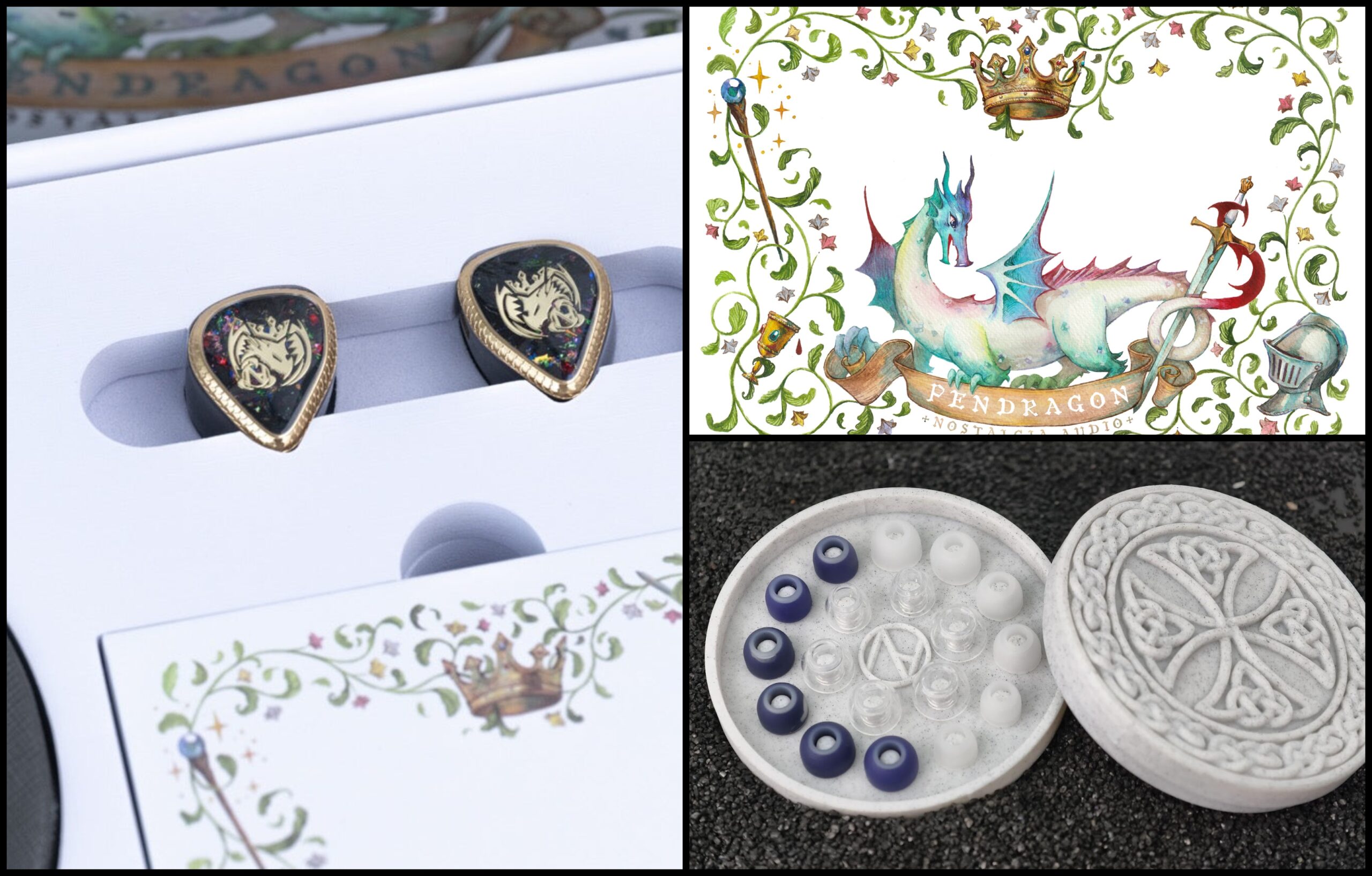
Nostalgia Audio has always impressed me with their packaging presentation and creativity. While fully black-themed packagings are widely used for flagship or premium products, this time, Nostalgia Audio freshened up Pendragon with a white-themed packaging. With the box design entailing the lore behind Pendragon, the overall presentation feels deliberate rather than ornamental.
Opening the box reveals the earpieces placed neatly with the accessories stored underneath. Other than the earpieces, Pendragon comes with the Pendragon-exclusive Caliburn Cable, a premium handmade leather case, a metal warranty card, Nostalgia Earpiece Mesh bags, 3 pairs of Symbio W tips, 3 pairs of Nostalgia XWB tips, 3 pairs of liquid silicone tips, and an eartip case that includes all the above assortment of eartips. With a matte white tone and textured surface, this dedicated eartip case is modeled after the Round Table of Knights using 3D printing. Not only does it serve as a decorative ornament, but also a practical accessory to store various eartips.
Early featured from the Nostalgia Audio Durandal, Pendragon is included with the ‘Royal Blue’ Symbio W tips that are NA-exclusive. The included handmade case feels noticeably more premium than most leather cases you would find on the market. The case is considerably larger than a typical carrying case, ensuring enough room for both stock and thicker aftermarket cables to be stored safely without being pressed, while not being too large to have the earphones rattle inside.
Stock Cable: Caliburn, The Exclusive
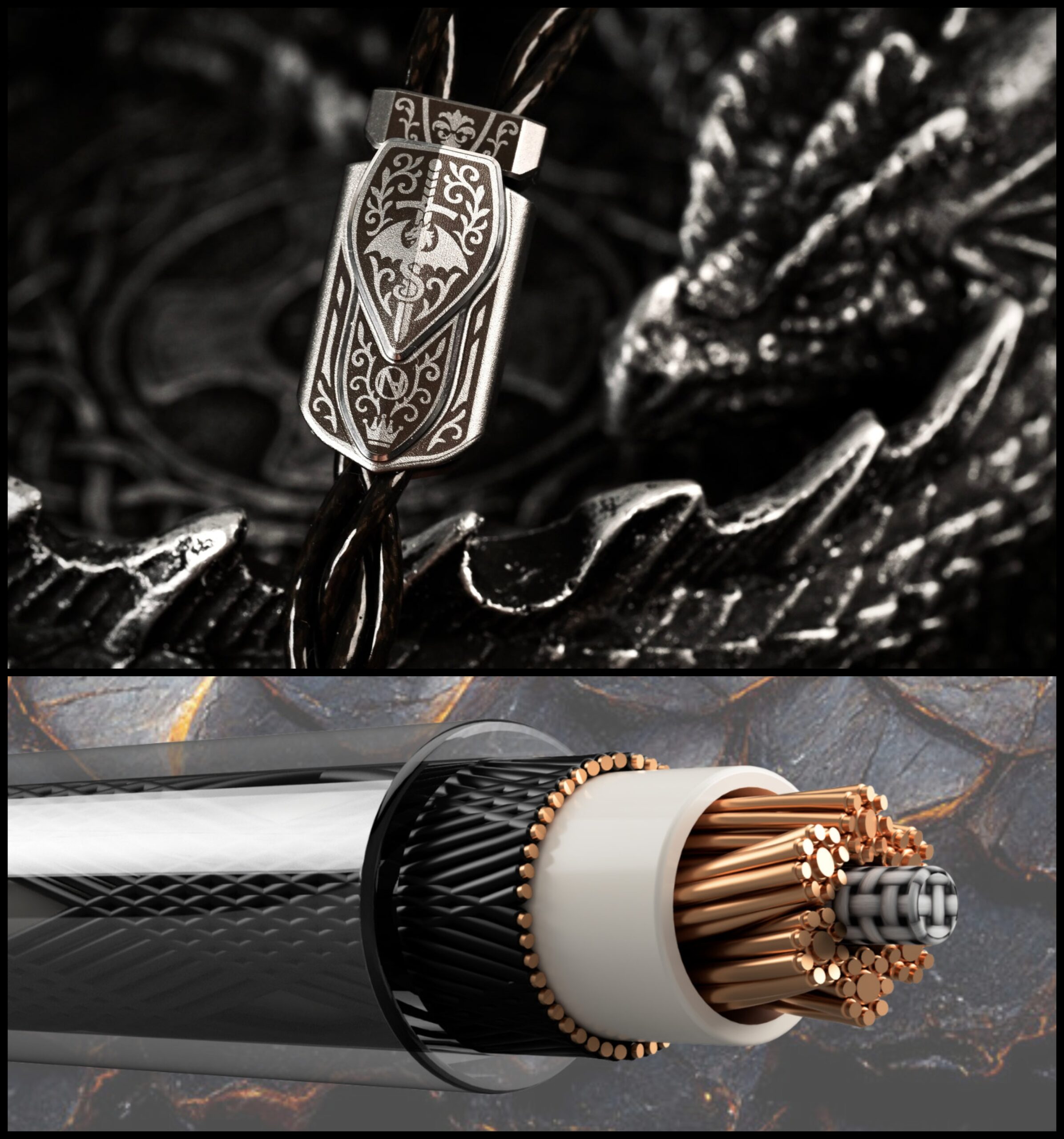
Pendragon comes bundled with an exclusive, flagship-tier stock cable named the Caliburn, designed exclusively for this model. Unlike Durandal, Nostalgia Audio’s collaborative project with Vortex Cables, Caliburn is tuned solely by the Nostalgia team themselves, and specifically for the goal of complementing Pendragon’s performance and desired sound signature. Visually, the cable adopts a black and gray dual-tone finish with subtle texturing that ties in with Pendragon’s dragon-scale motif. The cables are terminated in 2pin-4.4mm connectors.
Caliburn uses a four-strand braided structure with a Litz Type 4S configuration, employing 4N German OFC copper as the core material. A coaxial shielding structure is applied, with an inner mesh made from silver-plated OFC copper to help minimize interference during signal transmission. Both the core and outer layers are PVC-coated, giving the cable a reassuring level of protection while remaining flexible enough for daily use. In terms of handling, Caliburn feels light, pliable, and has the right amount of thickness. For further details, below are the detailed specs of the Caliburn.
CABLE SPECIFICATION
Core Gauge: 21.5 AWG
Cable Diameter: 1.8 mm
Weaving Method: 4-strand braided
Core Structure: Litz – Type 4S
Core Material: 4N German OFC Copper
Outer Jacket: Custom SoftFlex PVC from the USA
Termination: OFC High Quality 4.4mm Balanced Termination
Earpieces (1/4): The Dragon-Skin Body
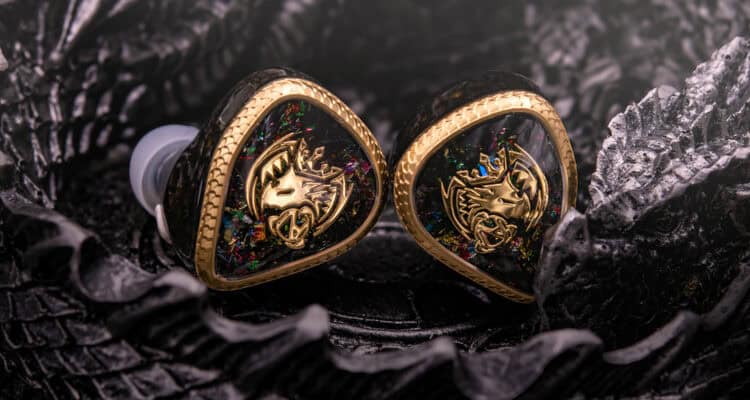
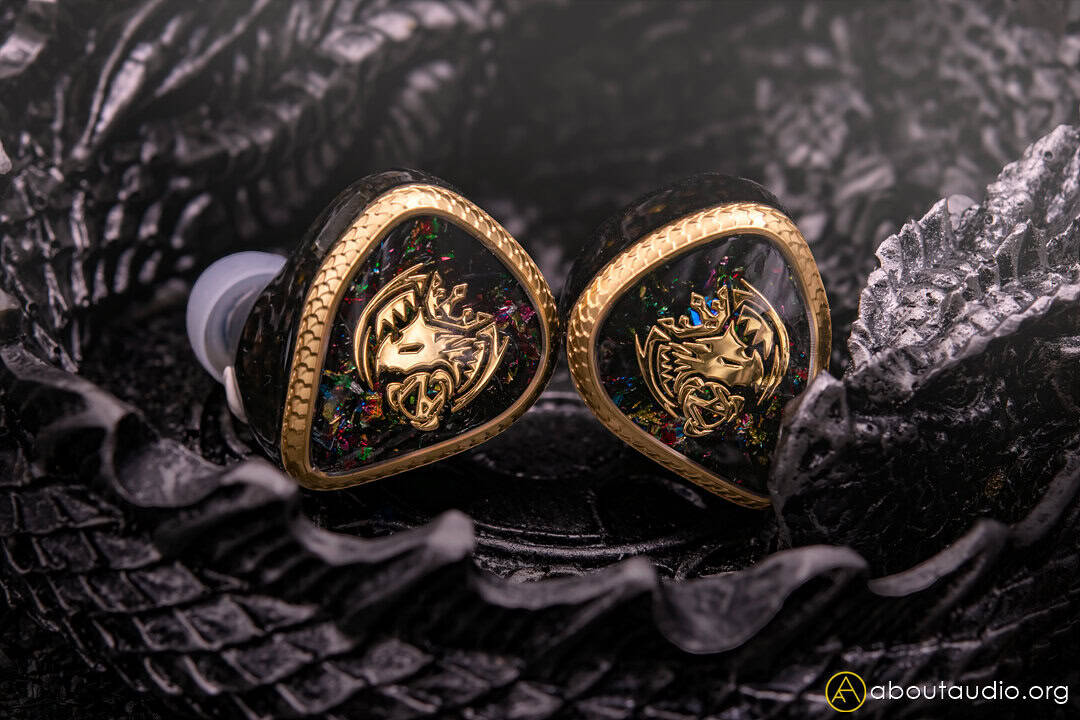
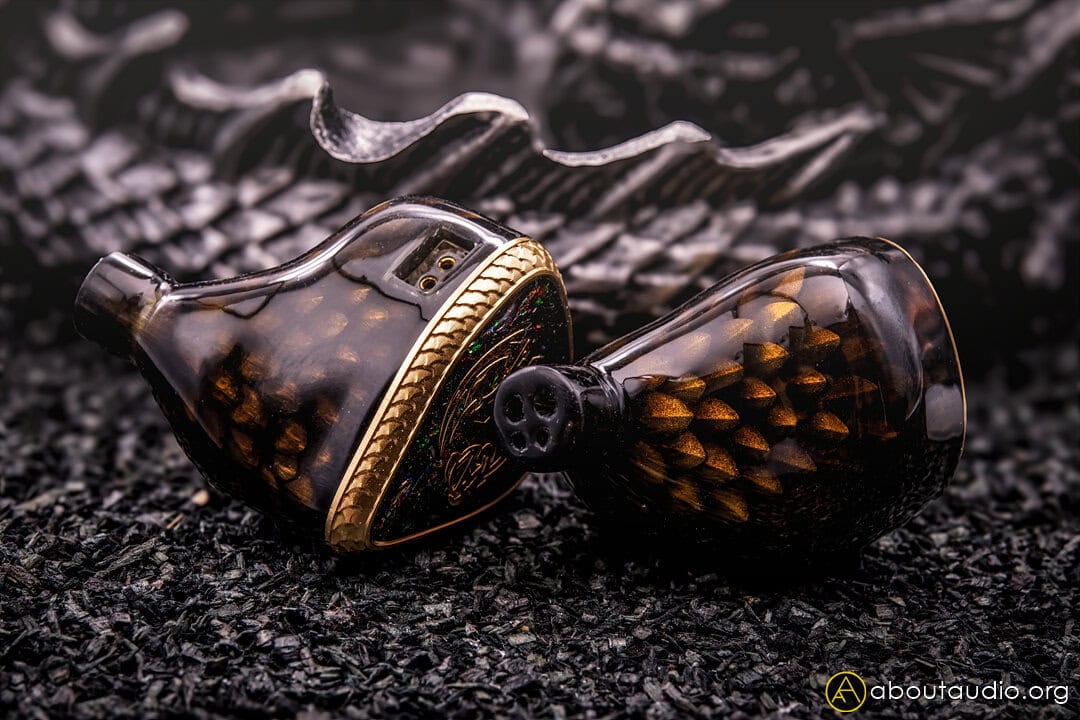
Pendragon’s faceplates are built around a layered carbon fiber design, patterned to resemble dragon scales. The shimmer is subtle yet gives off a very premium look without getting flashy, showing different hues depending on the angle of light. Pendragon is also topped with a gold dragonscale rim, finely machined with CNC for achieving a smooth surface and in-depth details. The faceplates feature ‘The King’s Treasure Vault’, which is a multi-color, fragmented, carbon fiber panel. The PD (short for Pendragon) shells are on the thicker side than standard IEMs, yet the inner body is smoothly contoured and ergonomic, so the fit feels natural once worn. Great design that nods to the dragon theme without overcomplicating things.
Per-side, Pendragon uses a 14-driver, quad‑hybrid system. Two custom 9.2mm dynamic drivers for the bass, while two bone conduction drivers reinforce the lower mids. Six balanced armatures cover mids and highs, and four electrostatic drivers for the ultra highs. On paper, Pendragon carries a 19-ohm impedance with a sensitivity rated at 115dB, though to get the full potential of Pendragon, I suggest using a DAP that offers powerful enough output or using an amplifier.
Earpieces (2/4): Spin the Sound, with Spiral Flow Device II (SFD II)
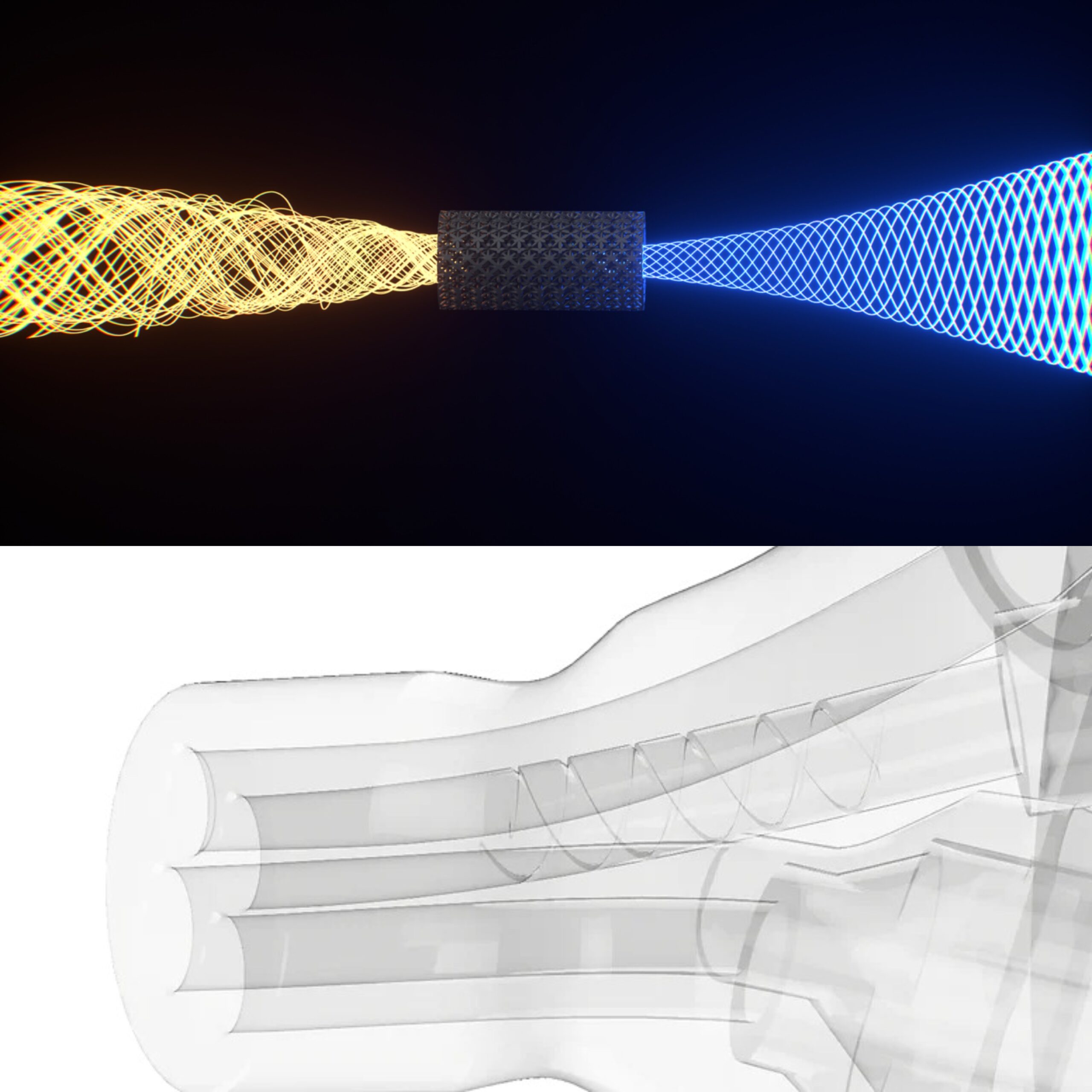
As with most earphones, sound generated from the drivers must travel through acoustic tubes before reaching the nozzle. Along the way, certain frequency ranges (especially higher frequencies) are prone to phase inconsistencies and energy loss. Featured earlier on Camelot and Tesseract, Nostalgia Audio’s original SFD system addressed this by engraving spiral grooves inside the sound tube, helping maintain momentum and precision for high-frequency transmission.
Pendragon introduces the second-generation SFD II, which takes the same concept further using micro-nano 3D printing. Instead of simple grooves, SFD II employs a finely controlled helical ridge structure within the acoustic chamber. This creates a subtle vortex effect that stabilizes sound energy in the critical 3–5kHz region. In practice, this refinement is aimed less at boosting clarity, reducing phase distortion, and improving coherence through the upper-mids.
The grooves are refined into a micro‑ridge structure, printed with higher precision, creating a vortex effect inside the chamber. This reduces phase distortion in the 3–5kHz range and helps vocals sound clearer, with better articulation on small details like lip and throat resonance. It’s essentially the same principle as before, but executed with finer geometry and accuracy.
Earpieces (3/4): Season up those Drivers, with E.S.C II Technology
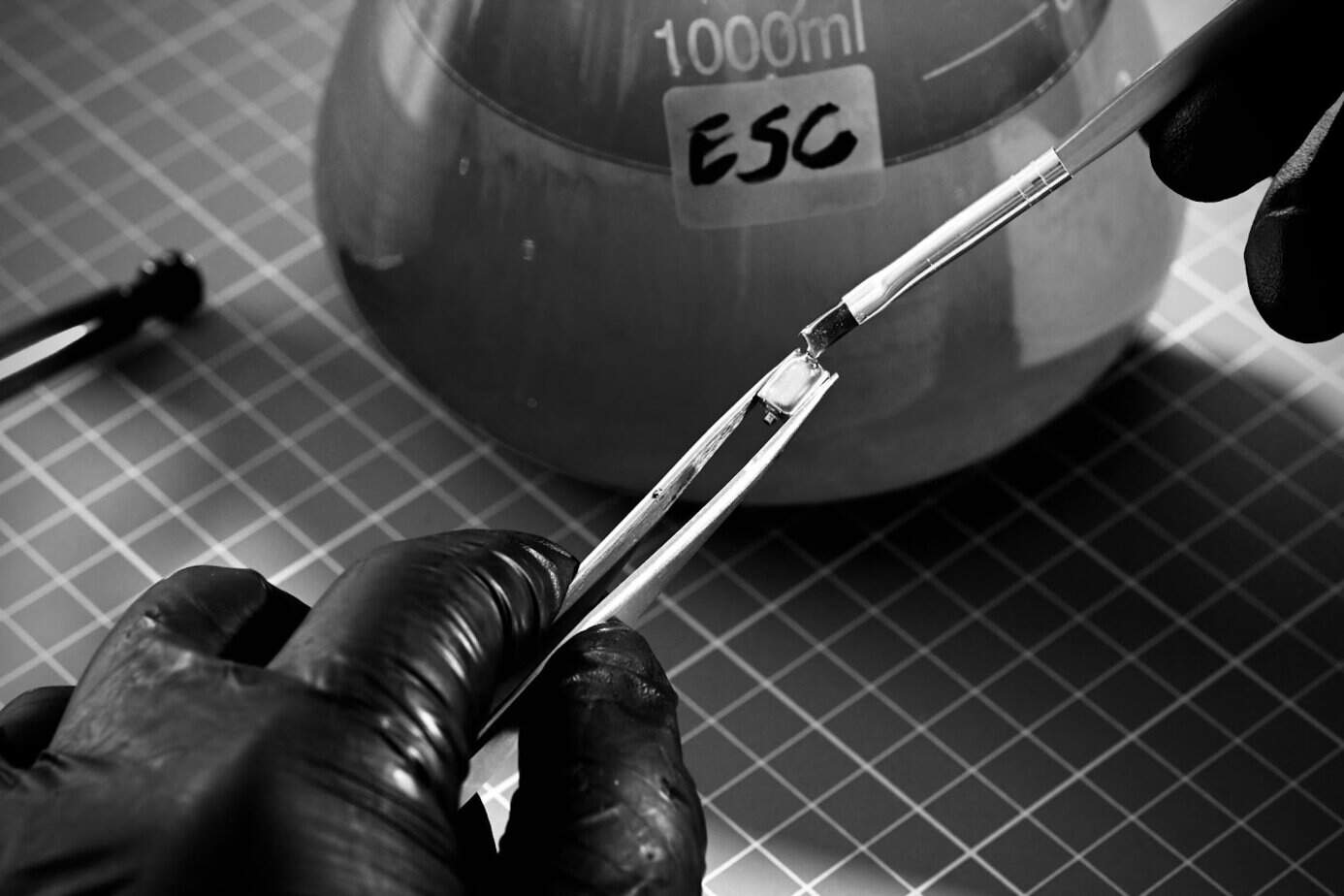
First featured on the Nostalgia Tesseract, the E.S.C. (Electromagnetic Shielding Coating) Technology returns in Pendragon with a 2nd-gen update. Continuing Nostalgia Audio’s approach of addressing interference at the driver level rather than downstream. As before, the coating is applied directly to the driver units and consists of a composite blend of metal oxides and conductive polymers. Its role remains the same: blocking unwanted electromagnetic interference that can subtly affect signal integrity.
In Pendragon, the formulation and application process have been refined. The updated coating achieves a higher attenuation rate against electromagnetic waves, effectively acting as an invisible barrier around the drivers. From the listening side, this translates to lower perceived distortion and a cleaner background, especially noticeable during quieter passages or complex layering. It’s not a flashy feature, but one that quietly supports Pendragon’s focus on resolution and control.

Earpieces (4/4): Bass, Structurally Reinforced, with XBS II (Extreme Bass System II)
Pendragon’s low-frequency system is built upon Nostalgia Audio’s XBS architecture, now updated to XBS II. The concept remains centered on delivering bass that is both physically engaging and controlled, but several structural changes have been made to refine its behavior. The system uses custom 9.2mm dynamic drivers, paired with upgraded internal materials designed to reduce unwanted resonance.
One of the key changes is the use of titanium alloy components in the driver connection structure, replacing earlier materials to better suppress harmonic distortion. In addition, micro-nano 3D printing is used to create highly precise internal airflow paths, allowing finer control over pressure and transient response. Rather than simply increasing bass quantity, XBS II focuses on tightening decay and improving definition, aiming for low-end weight that doesn’t blur into the midrange.
Next Page: In-depth Sound Impressions of Pendragon